
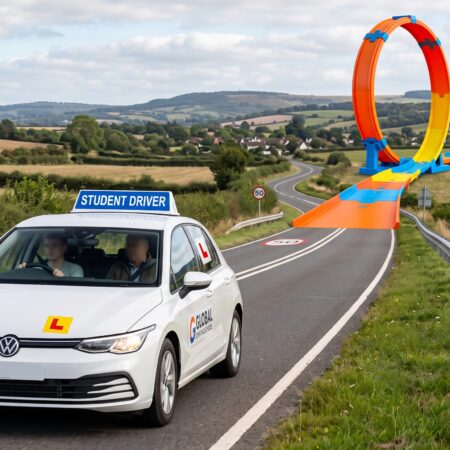

What if passing the driving test is not the end of learning, but the moment we accidentally stop it?
There is a curious phenomenon in psychology known as the Zeigarnik effect.
In simple terms, it describes the tendency for unfinished or interrupted tasks to remain more prominent in our minds than completed ones. An unfinished task can create a kind of mental tension: something remains unresolved, and therefore something in us wants to return to it.
The effect takes its name from Soviet psychologist Bluma Zeigarnik, who became interested in the phenomenon after observing something rather mundane but revealing: waiters appeared to remember unpaid orders particularly well, yet once an order had been paid and settled, their ability to recall its details diminished (anecdotal). The observation led Zeigarnik to investigate whether interrupted or unfinished tasks remained more readily accessible in memory than completed ones. Her subsequent work helped establish what became known as the Zeigarnik effect, although later research has shown that the phenomenon is more nuanced and dependent upon circumstances than the original interpretation might suggest.
The effect is more nuanced than that simple description suggests, and modern research does not support treating it as a universal psychological law. Context, motivation, planning and the nature of the task all matter.
But there is an intriguing question hiding inside the idea.
What happens when something is deliberately presented to us as finished, even though it isn’t?
That question may have an unexpected application to road safety.
Specifically, to learning to drive.
The test is passed. So what happens next?
For generations, learning to drive has largely been structured around a very clear objective:
Pass the driving test.
There is nothing inherently wrong with having an assessment. A driving licence needs to mean something, and a practical test provides a mechanism for establishing whether a candidate has reached the required standard to drive independently.
But perhaps we have inadvertently created a psychological problem.
A learner takes lessons.
They learn the required techniques.
They practise.
They prepare for the test.
They take the test.
They pass.
And then comes the most significant word in the entire process:
Congratulations.
The loop is closed.
The learner is no longer a learner.
They are now a driver.
But have they finished learning?
Obviously not.
In fact, they have arguably just reached the point at which meaningful independent learning can properly begin.
So what if the structure of the system creates an unintended consequence?
What if the psychological perception of completion is contributing to the abandonment of further learning?
That is not a proven explanation for driver knowledge deterioration.
It is a hypothesis.
But it is an interesting one.
Learning to pass versus learning to drive
There has long been criticism of test-oriented driving tuition.
A learner needs to acquire the skills necessary to demonstrate competence under examination conditions. That inevitably means that lessons must address the requirements of the test.
But driving is considerably larger than the test.
A test takes place at one particular moment, under particular conditions, with particular expectations.
Real driving does not.
Real driving involves unfamiliar roads, changing road layouts, different weather, tiredness, distraction, other people’s mistakes, changing technology, changing legislation and situations that a learner may never have encountered during instruction.
A driving test cannot possibly encompass all of that.
Nor should it.
The test has a defined purpose.
The problem may therefore be less about what the test assesses and more about what we psychologically believe passing the test means.
If passing means:
“I have demonstrated the required competence to drive independently.”
that is reasonable.
If passing becomes:
“I have finished learning how to drive.”
we have a problem.
The closed-loop hypothesis
Here is where the Zeigarnik effect provides an interesting lens.
If unfinished objectives tend to remain cognitively active, then completing an objective can provide psychological closure.
Consider the difference between these two educational journeys.
Journey one
Learn → practise → test → pass → finished.
Journey two
Learn → practise → test → pass → continue learning.
The first contains a clearly defined endpoint.
The second deliberately doesn’t.
The first tells the learner that the objective has been achieved.
The second tells them that they have achieved one stage of a much larger objective.
That distinction changes everything, potentially.
Perhaps the problem is not that newly qualified drivers consciously decide they no longer need to learn.
Perhaps the problem is that we have given them every psychological signal that learning is now over.
Nobody tells you to revise for the rest of your driving life
Consider what happens with many other forms of learning.
A student prepares for an examination.
They study.
They take the examination.
They receive their result.
And unless further education is required, the immediate learning objective is complete.
Nobody expects them to continue revising the same examination syllabus indefinitely.
Driving is different.
The rules can change.
Road signs can change.
Vehicle technology changes.
Infrastructure changes.
Driver-assistance systems change.
Legislation changes.
Guidance changes.
Even the risks associated with particular behaviours can become better understood.
Yet many drivers do remarkably little to maintain their formal knowledge once they have obtained their licence.
Some may never again open a driving rule book.
Others may rely upon what they remember from lessons many years earlier.
Some might be influenced by a post on social media, or unconfirmed hearsay, cognitive bias playing a part.
And some will confidently insist that they know the rules while being unable to explain rules that have changed since they qualified.
This is the phenomenon we might call knowledge corrosion.
But perhaps we have been looking at the wrong end of the process.
We have tended to ask:
Why don’t drivers keep their knowledge up to date?
Perhaps we should also ask:
Did we ever give them a reason to believe that they were supposed to?
The licence as a psychological full stop
There is something powerful about receiving a driving licence.
It is physical evidence of achievement.
You have passed.
You are qualified.
You are independent.
You can drive.
That is precisely what it should represent.
But psychologically, it can also become a full stop.
The learning journey has a beginning.
It has a curriculum.
It has an examination.
And it has a tangible reward.
The licence.
After that, there is no universally recognised equivalent of:
“Now you need to keep learning.”
There is no annual driving knowledge examination for most drivers.
There is no routine requirement to demonstrate that you understand changes to the rules.
There is no cultural expectation that a competent driver should periodically refresh their knowledge.
And there is rarely any social embarrassment attached to admitting:
“I haven’t read the rules since I passed my test.”
In fact, the opposite can happen.
Years of driving can create confidence.
Confidence can create the belief that experience is equivalent to knowledge.
And experience, of course, is not necessarily knowledge.
Experience can reinforce the wrong lesson
There is another intriguing question here.
A driver can drive for twenty years without ever being involved in a serious collision.
That experience can quite reasonably make them feel competent.
But it doesn’t necessarily tell them whether their understanding of the current rules is accurate.
They may have accumulated twenty years of experience.
Or they may have accumulated one year of experience twenty times.
If the driver has never had a reason to revisit their knowledge, the absence of negative consequences may reinforce the belief that everything they are doing is correct.
That creates another possible closed loop:
I passed → I drive successfully → therefore I know how to drive → therefore I don’t need to learn anything else.
But the conclusion does not necessarily follow.
What if the problem begins with the message?
Perhaps the solution does not begin with another test.
Perhaps it begins with changing the message.
Imagine if the final lesson before a driving test contained an entirely different message.
Not:
“Once you pass, you’re a qualified driver.”
but:
“Once you pass, you are qualified to continue learning independently.”
The licence would still mean exactly what it needs to mean.
The test would still establish competence.
Nothing about the legal threshold would need to change.
But the psychological meaning could change considerably.
Passing would become a milestone rather than a destination.
Could we deliberately keep the learning loop open?
This is where the hypothesis becomes particularly interesting.
What if driver education was designed around the principle that the learning loop should never completely close?
Not because drivers should be made anxious.
Not because everybody should constantly feel that they are failing.
And certainly not because driving should become an endless examination.
Quite the opposite.
Continuing learning could be positive.
It could be curious.
It could be practical.
It could even be enjoyable.
A driver might occasionally encounter a question such as:
Would you still pass your theory test today?
Or:
Do you know what has changed since you learned to drive?
Or:
Why does this rule exist?
Or simply:
When was the last time you checked?
Those questions don’t accuse.
They invite.
And perhaps that is the important distinction.
From examination to curiosity
This brings us back to the Zeigarnik effect.
If an unanswered question can remain mentally active, perhaps road-safety education could make better use of questions rather than simply providing information.
Instead of:
“The rules say…”
we might sometimes begin with:
“What do you think the rules say?”
Instead of:
“This is the correct procedure.”
we might ask:
“What would you do here?”
Instead of:
“Remember that this rule changed.”
we might ask:
“Did you know this rule changed?”
The answer then becomes the reward for engaging with the question.
The loop opens.
The driver becomes curious.
The information provides the answer.
The loop closes.
And then, ideally, another useful question opens.
That is not about keeping people perpetually confused.
It is about making learning itself part of being a driver.
But is this actually happening?
We need to be careful here.
The hypothesis is compelling.
It fits neatly with established ideas about motivation, cognitive closure, learning and unfinished goals.
But that does not mean we can currently say:
“The Zeigarnik effect causes drivers to stop learning after passing their test.”
We cannot.
That would be going considerably further than the evidence allows.
There are many possible explanations for declining driver knowledge.
People are busy.
Rules can be complicated.
Information is not always presented well.
Drivers may not know where to find authoritative updates.
There is little external incentive to refresh knowledge.
Experience can produce overconfidence.
And many people simply do not perceive driving as an activity that requires continuing education.
The closed-loop hypothesis could be one contributing factor among many.
And perhaps that is precisely why it deserves investigation.
What if we have designed the endpoint incorrectly?
This may ultimately be the more important question.
We have created an education system in which the learner works towards a clearly defined endpoint.
Pass the test.
Obtain the licence.
Drive independently.
But driving itself has no endpoint.
There is no final level.
No ultimate qualification.
No point at which somebody can reasonably say:
“I now know everything there is to know about driving.”
So perhaps the educational system needs to distinguish between two things:
Being qualified to drive
and
being finished with learning about driving.
They are not the same thing.
Perhaps they were never supposed to be.
And that leaves us with an uncomfortable question
If a newly qualified driver believes that passing their test means their driving education is complete, who taught them that?
Was it the instructor?
The examination system?
The language we use?
The certificate?
The culture surrounding driving?
Or simply the structure of the process itself?
And if we discovered that the very act of passing creates a powerful sense of completion, what would happen if we deliberately changed what passing meant?
What if the most important lesson delivered on the day someone receives their licence was not:
“You’ve passed.”
but:
“You’ve passed this stage.” Or, in gaming terms perhaps, “Level Completed.”
Because perhaps the greatest weakness in driver education isn’t that we fail to teach people enough before they pass.
Perhaps it is that we teach them to believe they have finished learning when they pass.
We don’t yet know whether the Zeigarnik effect has anything to do with that.
But perhaps somebody should ask.
And perhaps that is where the next piece of the road-safety conversation begins.

Other Articles
More Than a Guide: The Thinking Behind N332 Signpost