Project Understanding Header

Project Understanding Manifesto

The road is one of the most complex social environments we enter every day.

Millions of people move through it together, each with their own expectations, habits, distractions, and decisions.

Yet most of us receive only limited education about how our own minds behave within that environment.

We assume we see everything.
We assume we react instantly.
We assume that mistakes happen to other people.

But the reality is very different.

Human perception is limited.
Attention is fragile.
Reaction takes time.
Habit shapes behaviour.

Most incidents on the road are not the result of deliberate danger, but of ordinary people navigating a complex system without fully understanding how it works.

Project Understanding exists to change that.

Not through blame.
Not through fear.
But through knowledge.

Because when people understand the limits of perception, the importance of time and space, and the shared responsibility we all carry, they begin to see the road differently.

And when people see differently, they behave differently.

Safer roads begin with understanding.

Mark Nolan
Mark Nolan

Latest Resources

Project Understanding

Changing the way we think about road safety

Road safety is often discussed in terms of rules, penalties, and enforcement. Yet most incidents on the road are not the result of deliberate recklessness, but of human limitations, misunderstanding, and habit.

Project Understanding explores the deeper reasons behind road behaviour — from psychology and perception to culture and responsibility — with the aim of helping people make safer decisions.


The Core Idea

Safer roads begin with understanding

Driving is not simply about controlling a vehicle. It is a complex cognitive activity that depends on attention, perception, judgement, and reaction. These processes are influenced by the limits of the human brain, the design of the environment, and the behaviour of others.

When we understand these factors, we begin to see road safety differently.

Instead of asking only who made the mistake, we start to ask:

  • What happened?

  • Why did it happen?

  • What allowed it to happen?

This shift in thinking opens the door to meaningful change.

Project Understanding explores the deeper reasons behind road behaviour — from psychology and perception to culture and responsibility — with the aim of helping people make safer decisions.
A Lifetime Learning Approach

Road behaviour is not formed the day someone passes a driving test. It develops gradually through observation, experience, and social influence.

Project Understanding therefore approaches road education as a lifetime journey.

Early Awareness

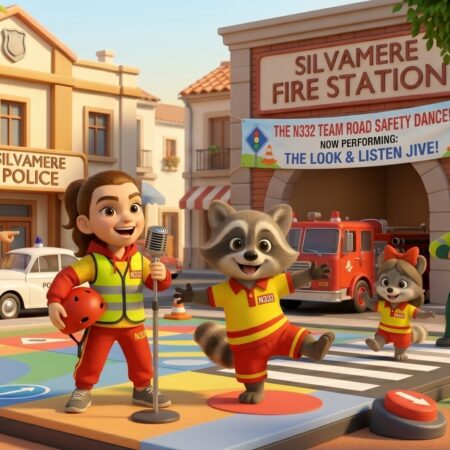
Through the world of Trafford and Friends, young children learn about awareness, visibility, and shared space through stories, music, and imagination.

Growing Responsibility

As children become teenagers, the focus shifts to Riley, who explores mobility, independence, and decision-making in ways that resonate with young people.

Adult Understanding

Through the N332 project and related work, adults are encouraged to reflect on behaviour, responsibility, and the psychology of driving.

Together these elements form a continuous educational ecosystem.

Beyond Rules and Fines

Traffic law is important. Enforcement is necessary. But rules alone cannot create safe roads.

Human behaviour is influenced by:

  • cognitive load

  • perception limits

  • reaction time

  • expectation and habit

  • social behaviour and culture

Project Understanding explores these factors to help explain why even well-intentioned drivers sometimes make dangerous decisions.

Understanding these realities allows individuals and communities to make better choices.

Learning Together

One of the central ideas behind Project Understanding is shared learning.

Children observe adults.
Teenagers model behaviour they see around them.
Drivers influence one another every day.

Improving road safety therefore requires participation from everyone.

Education must extend beyond classrooms and driving schools into homes, communities, and conversations.

Education in Action

Project Understanding is not limited to theory.

Through collaborations with schools, community talks, and media initiatives, the project encourages people to engage directly with the ideas.

Students may explore road safety through writing, art, music, and discussion. Peer ambassador programmes allow young people to share knowledge with one another. Public talks and articles continue the conversation among adult audiences.

The goal is not simply to deliver information, but to encourage curiosity, reflection, and dialogue.

An Ongoing Project

Project Understanding is continuously evolving.

This website will gradually expand to include:

  • articles exploring the psychology of driving

  • discussions about road behaviour and culture

  • research and statistics

  • podcasts and video content

  • educational materials and resources

The intention is to build a space where people can explore road safety from a deeper perspective.

Project Understanding

Project Understanding from N332
Mark Nolan, Riley Via-Silva, and Trafford

Recent Resources

Our Partners

Project Understanding Logo

Our site uses cookies. By using this site, you agree to the Privacy Policy and Terms of Use.