

Project Understanding is the philosophical framework behind the entire initiative.
Its aim is not simply to instruct people to obey traffic rules or avoid fines.
Instead, it seeks to help people understand:
- how the human brain behaves in traffic environments
- why mistakes occur
- how cognitive load, perception, and habit influence behaviour
- how active errors and latent conditions interact
- why shared responsibility is essential for safer roads
The project therefore focuses on understanding rather than blame.
To achieve this, the work is structured as a lifetime learning pathway, where the same core ideas are communicated differently at different stages of life.
Layer 1 — Early Childhood
Trafford and Friends (0–10)
Trafford and Friends introduces the earliest awareness of road environments.
The central character is Trafford, the N332 road safety raccoon, supported by characters such as Tammy and Trent. They live in the fictional town of Silvamere.
Education at this stage is delivered through:
- stories and animation
- songs (often performed by Tammy)
- colouring books and story books
- Trafford podcasts and videos
- YouTube content
- school presentations
Children are not being taught laws or penalties. Instead they are developing habits such as:
- looking for signals and cues
- recognising colours and patterns
- understanding that roads are shared spaces
- associating visibility with safety
Several psychological ideas are quietly embedded:
- colour psychology (yellow representing visibility and safety)
- narrative learning through the world of Silvamere
- curiosity triggers such as the “people inside traffic lights”
Importantly, the materials are designed so children and adults learn together.
Layer 2 — Adolescence and Early Adulthood
Riley (approximately 10–20+)
Riley acts as the bridge between childhood awareness and adult responsibility.
She evolves as the audience grows.
- Animated Riley represents younger teenagers.
- Human-like Riley represents late teens and young adults.
The transition between these forms is gradual, allowing the audience to grow alongside the character.
Visual identity
Riley represents the transition between Trafford and adulthood.
Colour symbolism reflects this progression:
- Trafford: yellow (visibility and safety)
- Riley: yellow and red (transition and responsibility)
- Adult presenters: red (authority and seriousness)
Riley’s communication channels
Riley engages with young people through platforms they naturally use:
- books (Riley’s Road and Riley’s Road Manual)
- podcasts
- music
- TikTok and Instagram
- videos
The two books form an important shared learning model.
Riley’s Road
Accessible explanations aimed at younger readers.
Riley’s Road Manual
The same chapters but with deeper explanations, statistics, and behavioural science.
This allows teenagers and parents to learn together.
Riley’s music and social media
Riley’s music career serves as a relationship-building tool.
Songs are not primarily about road safety. They are normal music content that allows audiences to connect with Riley as a person.
Safety ideas appear naturally rather than as lectures.
Layer 3 — Adult Engagement
N332
The adult layer is rooted in the real-world N332 road safety project.
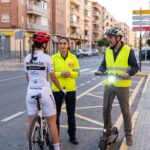
N332 began more than eleven years ago through the initiative of Guardia Civil traffic officer Francisco Javier Moravis.
He repeatedly observed the same traffic violations, particularly among foreign drivers unfamiliar with Spanish traffic law. Instead of relying solely on fines, he wanted to educate drivers first.
Through collaboration with you, that information was translated conceptually into a form international drivers could understand.
Today N332 continues through:
- educational talks
- public information campaigns
- explanations of Spanish traffic law
- discussions of behaviour and road culture
These talks often involve audiences of hundreds of people at a time and address the complexities of driving in an international environment.
The School Implementation Layer
ELIS Pilot Programme
A major new development is the collaboration with El Limonar International School Villamartín, commonly referred to as ELIS.
This school has acted as the pilot environment for integrating the Project Understanding ecosystem directly into an educational setting.
During the current programme:
- you have delivered presentations to multiple age groups
- Trafford content has been used for younger children
- Riley content has been used for teenagers
This pilot programme is designed to expand beyond presentations and become a participatory learning model.
Student Competitions
The next phase involves a series of creative competitions allowing students to engage actively with the ideas.
Possible competitions include:
- short story writing
- songwriting
- drawing and colouring
- video creation
The aim is to integrate road safety themes into existing curriculum skills, including:
- language and writing
- art and creativity
- media production
- storytelling
Selected work can then be published through media partners such as:
- The Leader newspaper
- Big Radio Spain
Students therefore gain real recognition, and their work can even appear in published formats such as books.
This creates an important outcome: the message leaves the classroom and enters the home environment.
N332 Ambassadors
Another major component of the school programme is the introduction of N332 Ambassadors.
These would typically be students aged around 14–16.
Their role is to act as a communication link between:
- students
- the school
- N332
A crucial principle of this system is that it operates without blame or punishment.
Students can ask questions about road safety, behaviour, or legal issues in a safe environment without fear of criticism.
Ambassadors also develop valuable life skills, including:
- communication and presentation
- leadership
- legal awareness
- peer education
They help distribute new information within the school community as legislation or safety advice changes.
The Cultural Objective
At the heart of the entire ecosystem is a simple but powerful idea.
Children observe adult behaviour.
If adults regularly ignore traffic rules — rolling through stop signs, speeding, ignoring signals — those behaviours become normalised.
Project Understanding therefore seeks to influence all generations simultaneously, so that the behaviour children observe reinforces the lessons they are taught.
The Core Principle
Driving is not only a mechanical skill. It is a human cognitive activity performed within a complex social system.
Collisions rarely occur because a single person deliberately acts dangerously. They arise through combinations of:
- human limitations
- environmental conditions
- social behaviour
- system design
Understanding these factors allows responsibility to be exercised more thoughtfully.
The Core Philosophy
At the centre of all three layers is the same fundamental idea.
Road safety problems rarely arise simply because people intend to behave dangerously. They arise because:
- the human brain has limitations
- environments contain hidden risks
- habits develop over time
- behaviour is influenced by social norms
This is why Project Understanding focuses on active errors and latent conditions rather than blame.
When people understand why incidents occur, they are more likely to change behaviour voluntarily.
Cultural Change
One of the most important elements in your approach is the recognition that behaviour is learned socially.
Children may be taught safe practices, but if they repeatedly see adults behaving differently, those lessons are quickly undermined.
For this reason, Project Understanding emphasises that everyone influences everyone else.
A simple act such as acknowledging another driver’s courtesy can affect the tone of the road environment.
Conversely, the erosion of courtesy contributes to frustration and aggression, which in turn increases risk.
The Shared Responsibility Model
Your philosophy ultimately rests on a balanced principle.
Drivers must accept responsibility for their decisions.
At the same time, society must recognise that behaviour is shaped by psychology, environment, and culture.
Understanding these factors allows improvements to be made across the system.
In this model:
- children learn awareness
- teenagers learn responsibility
- adults learn reflection and system thinking
Each generation helps shape the behaviour of the next.
The Long-Term Vision
When viewed together, the elements of your work form something larger than individual campaigns or educational materials.
They create a continuous culture of learning about road behaviour.
People encounter the same core ideas:
- as children through Trafford
- as teenagers through Riley
- as adults through N332 and Project Understanding
Over time this repetition builds a deeper understanding of how road safety actually works.
And when understanding becomes widespread, safer behaviour follows naturally.