
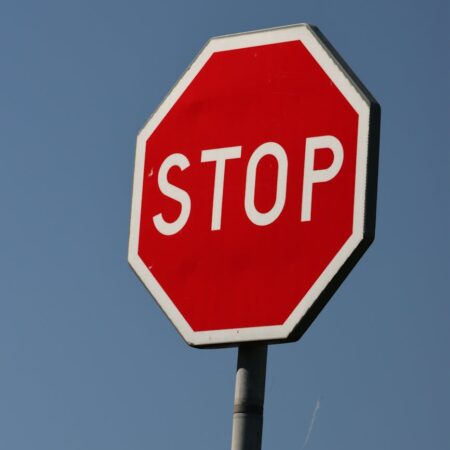

Few road signs are as recognisable as the stop sign.
Its shape is distinctive.
Its colour is bold and unmistakable.
And the message could not appear simpler.
It says one word: STOP.
Most drivers know exactly what the sign means. It requires a complete stop before entering the junction, normally at the solid white stop line painted across the road.
Yet in everyday driving, something very different often happens.
Drivers slow down.
They roll forward slightly.
They glance quickly left and right.
And then they continue without ever fully stopping.
This behaviour is so common that it has almost become normal. Many drivers treat a stop sign as if it were simply a stronger version of a give way sign.
This is what might be called the stop sign fallacy — the belief that the sign exists only to control movement, rather than to create time for thinking.
Contents
What the Stop Sign Really Means
On the surface, the instruction appears simple: stop the vehicle.
But the purpose of stopping is not merely to bring the car to a halt. The real purpose is to create a moment in which the driver’s brain can properly assess the situation.
When a vehicle is moving, even slowly, the brain is still processing multiple tasks at once:
- maintaining control of the vehicle
- judging speed and position
- scanning for approaching traffic
- predicting what other road users might do
If the vehicle continues rolling forward, these processes remain compressed into a very short window of time.
A complete stop changes that.
When the vehicle stops, the driver gains a moment to focus entirely on observation. The brain can scan the environment more carefully and detect hazards that might otherwise be overlooked.
In other words, the stop sign is not only about stopping the vehicle.
It is about giving the brain enough time to understand what is happening.
The Human Factor
Human perception is not instantaneous.
The brain must first notice something, then interpret what it means, and finally decide how to respond. This process takes time, and that time becomes especially important at junctions where vehicles from different directions intersect.
A rolling movement through a stop sign removes the very pause that allows the brain to perform this assessment.
Drivers may believe they have looked carefully, yet their brain may not have fully registered what is approaching.
This is one reason why drivers sometimes say after a collision, “I looked but I did not see them.”
Junctions and Risk
Junctions are among the most complex environments on the road.
Multiple streams of traffic may intersect. Vehicles can approach from different directions and at different speeds. Pedestrians and cyclists may also be present.
In Spain, as in many countries, data consistently shows that collisions at junctions represent one of the most common types of urban traffic incidents.
This is not surprising. Junctions require drivers to make rapid decisions while processing multiple sources of information.
The stop sign exists precisely to slow this process down.
By requiring drivers to stop completely, it creates a moment in which observation and judgement can take place without pressure.
More Than a Word
The stop sign appears simple because the instruction is expressed in a single word.
But that word carries far more meaning than it first appears.
It means:
Stop the vehicle.
Pause the movement.
Allow the brain to observe.
Assess the risks.
Then decide whether it is safe to continue.
When drivers treat the sign as merely a suggestion to slow down, they remove the very function it was designed to provide.
The stop sign is not simply about obedience to a rule.
It is about creating the time necessary for safe decision-making.
And in an environment where seconds and metres can determine the outcome of an encounter, that moment of pause can make all the difference.

Other Articles
Skill Cannot Replace Time
Why Courtesy on the Road Still Matters